Book in PDF format, letter-size sheets with a learning methodology and highly detailed usage instructions.
Multilingual
Our services are growing; we initially started with 3 languages:
- English
- Spanish
- German
We are expanding to new languages to be added. See personalization
AI Agent
The AI Agent stores, interprets, and delivers recommendations to parents. Everything is recorded in the child's file. You decide who to share this progress with.
Simple printing
No shadows - No thick outlines - Wide margins - Highly detailed material.
Ages 1–2
Exploratory material with Montessori and Waldorf methodology
Ages 2–3
Progressive material with Montessori and Waldorf methodology
Ages 5+
Theme-based material
Immediate delivery
Once the material is selected and your details are entered, the sheets are created and sent by email and direct download.
Pintagrow: Coloring books and personalized sheets for early childhood
Simple, repeatable and respectful materials to support early development. Download as PDF, print at home and observe progress without pressure.
All our books are personalized, with a unique serial number and validation QR. Multilingual.
PDF format ready to print
PDF • Letter size • Margins
Monochrome outline design for crayons
Outline • Clean
Ages 1–2, 2–3, and stage-based collections
Collections by developmental stage.
Our books
Materials to support early cognitive development
Pintagrow brings together a collection of coloring and tracing activity books, designed to accompany child development in a respectful and progressive way. The Montessori line prioritizes clarity, visual order, and activities that strengthen coordination, line control, and pre-writing skills. The Waldorf line emphasizes gesture, rhythm, and movement fluency, with gentle, organic proposals that encourage confidence and creativity without pressure on the outcome.
The collection covers stages from ages 1–2 (first scribbles), ages 2–3 (intentional scribbling), and ages 3–5 (shapes and lines), and includes thematic series with José Tomás for numbers and letters at ages 3–5, in a version that unifies Montessori and Waldorf. It also includes a coloring adventure book ("The Travels of José Tomás", approx. 4–6 years), focused on exploring and imagining without a rigid pedagogical method.
Together, these are friendly, printable materials aimed at developing fine motor skills, attention, creativity, and enjoyment, always keeping the focus on the child's process. Pintagrow is constantly growing, developing new books and experiences oriented toward the early cognitive development of children, expanding the collection with increasingly specific proposals for each stage of early childhood.
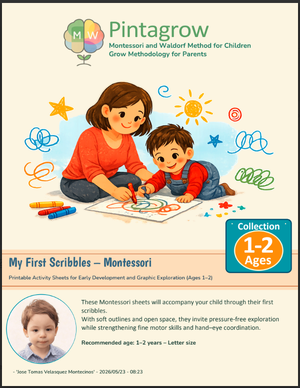
Montessori Ages 1–2 / My First Scribbles
A respectful first introduction to free mark-making, now structured as a complete 15-page Pintagrow sequence: cover and methodological guidance, one initial free sheet as an individual baseline, and 8 progressive Montessori activity sheets.
The free sheet helps observe the child’s zero point of spontaneous gesture before visual anchors are introduced. The following sheets move from simple open shapes toward paths, anchor selection, distributed attention, and integration of multiple elements.
The goal is not to color “correctly”, but to observe the process: sustained attention, return to the visual anchor, use of space, progressive gesture control, stroke pressure, and intentionality. Progress is compared with the child’s own baseline, not with other children.
Each analyzable sheet can be integrated with the Pintagrow platform through QR verification, adult observation, and photo upload, creating a history and general guidance to better support early development. The material is educational and not diagnostic.
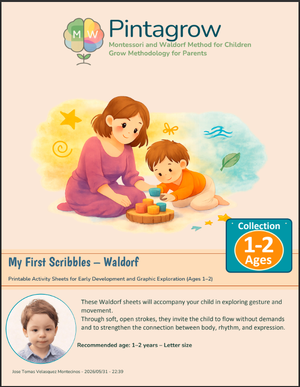
Waldorf Ages 1–2 / My First Scribbles
A first introduction to drawing as a bodily, rhythmic, and expressive experience, now structured as a complete 16-page Pintagrow sequence: cover and methodological guidance, one initial free sheet as an individual baseline, and 9 progressive Waldorf sheets.
The free sheet helps observe spontaneous gesture before visual stimuli are proposed. The Waldorf sheets then introduce open, organic, and fluid forms—sun, hills, moon, waves, rain, fish, rainbow, sprout, spiral, and leaf—to support rhythm, continuity, bodily regulation, and sustained interest.
The focus is not on closing shapes or producing a correct result, but on observing how the child explores movement, distributes attention, regulates stroke pressure, uses space, and remains engaged through sensory experience.
Each analyzable sheet can be integrated with the Pintagrow platform through QR verification, adult observation, and photo upload, creating a history and general guidance. The material is educational, preventive, and not diagnostic.
Methodologies
Three approaches, one goal
Pintagrow supports early childhood development through simple, brief, and carefully designed graphic experiences that allow the child to explore line, movement, and attention in a natural and respectful way.
The proposed activities progressively strengthen hand–eye coordination, fine motor skills, and self-regulation, focusing on the process of exploration, repetition, and bodily experience rather than on the final graphic result.
Through this approach, the adult learns to observe, accompany, and make conscious decisions about how to continue the process, respecting each child's individual pace and fostering a healthy, trusting relationship with learning from the earliest years.
Each approach plays a specific role within this system, but they all point toward the same goal:
To support early childhood development through respectful, brief, and meaningful graphic experiences centered on the process of exploration, movement regulation, and the gradual construction of attention.
Montessori Structure, simplicity, and autonomy in exploration
The Montessori approach in Pintagrow is expressed mainly through the design of the sheets and the way the child interacts with them.
Montessori sheets are characterized by:
simple, defined outlines,
clear and recognizable shapes,
wide blank spaces,
an absence of unnecessary visual stimuli.
This structure allows the child to focus attention on the gesture of the line, encouraging the gradual development of fine motor skills, hand–eye coordination, and movement control.
Blank space is not emptiness: it is an invitation to explore without distractions, to repeat the gesture, and to organize movement more clearly.
From this perspective, the adult presents the material and then observes, intervening as little as possible. The child decides how and how much to explore, strengthening autonomy and confidence.
Waldorf Gesture, rhythm, and expression through movement
The Waldorf approach in Pintagrow emphasizes the bodily movement and sensory experience of the line.
Waldorf-inspired sheets are characterized by:
soft, open strokes,
organic, continuous lines,
an absence of closed shapes or expected results,
invitations to fluid movement of the hand and arm.
These kinds of proposals support the fluidity of gesture, inner rhythm, and the connection between body, emotion, and movement. The line is not understood as a task to complete, but as a living experience.
The child may follow a rhythm, repeat a movement, or simply let the hand move freely, which contributes to bodily and emotional regulation.
From this perspective, development occurs when the child moves freely within a safe framework, without demands or external corrections.
Grow Method (for parents) Conscious observation, support, and process tracking
The Grow Method is aimed exclusively at the adult's role and runs through the entire use of the book.
Its purpose is not to teach techniques or indicate “how the child should act,” but to help mothers and fathers see development more clearly, with less anxiety and more confidence, based on everyday observation.
Through the Grow Method, the adult learns to:
observe the child's spontaneous interest time,
recognize how the child approaches the activity (curiosity, doubt, impulsiveness, calm),
identify which kinds of sheets support better regulation and attention,
decide consciously when to repeat a sheet, move on to another one, or take a pause.
Simple time tracking and preserving the sheets make it possible to visualize progress over time, without comparing the child with others or labeling behaviors.
Technological support in the Grow Method
For those who want it, Pintagrow offers a digital platform that allows the processing of the information recorded by the adult.
Through this platform, an artificial intelligence system analyzes the sheets and the data provided by mothers and fathers in order to organize information, detect patterns of development, and provide general guidance on how to continue the process.
Technology does not observe the child or participate in the activity.
Its role is to support the adult after the experience, helping them reflect on what was observed and make informed decisions.
A respectful, non-diagnostic approach
The Grow Method does not evaluate or diagnose.
The guidance provided, whether through the book or the digital platform, does not replace professional assessments or specialized interventions when they are needed.
Its approach is preventive, supportive, and formative, and seeks to strengthen the adult–child bond by promoting a more conscious, calm, and respectful relationship with development and learning.
In summary
The child explores and develops through direct experience, movement, and line.
The adult observes, supports, and records consciously, without over-intervening or directing the process.
Technology supports reflection and decision-making, without intervening in the experience or in the bond between the child and the adult.
That balance is the basis of the Grow Method.
Records, confidentiality, and use of information
All information generated during the use of this book—including scanned sheets, recorded interest time, adult comments, and the guidance provided by our artificial intelligence agents—is stored securely for future consultation.
This record has a clear purpose:
to allow a longitudinal view of development, that is, to observe the child's evolution over time without relying only on memory or isolated impressions.
The confidentiality of this information is essential. For this reason, the system is designed so that the responsible adult maintains control over access to, use of, and possible sharing of the records.
The content is not shared with third parties without authorization, and its use is intended solely for support, family follow-up, and, if the family considers it appropriate, complementary support in professional contexts.
Personalization
Pintagrow can generate personalized versions with identification and traceability.
Unique serial
When each Pintagrow book is issued, a unique serial code is generated specifically for that book, the responsible adult, and the child for whom it was created.
This code makes it possible to link the printed material with the digital platform, ensuring that every sheet used and recorded is correctly connected to the corresponding record.
Thanks to this system, every time you upload a scanned or photographed sheet, the platform can automatically identify which book, which child, and which support process it belongs to, without the need to enter repeated information.
What the unique serial is for
The serial code fulfills several important functions within Pintagrow:
Secure identification It guarantees that each recorded sheet corresponds to the correct book and the correct child.
Continuity of the process It makes it possible to build an orderly history of development, even if sheets are uploaded at different times.
Automatic authentication It avoids confusion between books, siblings, or different users within the same family.
Material traceability It makes it possible to verify that a sheet is part of an authentic Pintagrow book.
How it works in practice
The serial code is integrated into the book and each sheet through visible and non-visible elements (such as verification codes and security marks).
When the adult uploads an image of a sheet to the platform:
The system recognizes the book's serial code.
It automatically associates the image with the corresponding child.
It incorporates the record into the process history.
It allows personalized guidance to be generated based on that journey.
This process happens automatically, without interrupting the adult's or the child's experience.
A system designed for the long term
The unique serial not only enables daily use of the book, but also safeguards information for the future.
All information associated with that serial—sheets, times, observations, and guidance—is kept organized and available to:
review progress over time,
share information in a controlled manner,
or support future professional assessments, if the family decides so.
Control and privacy
The serial code does not contain visible personal information. Its function is technical and security-related, and its use is protected within the Pintagrow system.
The family always remains in control of:
what information is recorded,
what is shared,
with whom it is shared,
and for how long.
Verification QR
Each Pintagrow sheet includes a verification QR code, uniquely associated with the issued book and the support process of the child for whom it was created.
This code allows the system to automatically recognize the origin of the sheet when it is scanned or uploaded to the platform, linking it securely with the user who requested the material.
What the verification QR is for
The QR code plays a key role within the Pintagrow ecosystem:
Immediate identification of the book When a sheet is scanned or uploaded, the system identifies which book it belongs to, without the need to enter data manually.
Linking with the user and the child The QR makes it possible to associate the sheet with the responsible adult and the corresponding child, even when there are several books or profiles within the same family.
Continuity and order of records Each sheet is automatically integrated into the correct history, keeping the process organized and coherent over time.
Authenticity verification The QR confirms that the sheet is part of a valid Pintagrow book issued by the platform.
How it works in everyday use
The use of the QR code is designed to be simple and non-invasive.
When the adult decides to upload a sheet:
They scan the QR code or upload the full image of the sheet.
The system automatically recognizes the associated book.
The sheet is linked to the history of the corresponding child.
The record remains available for follow-up and future guidance.
The entire process happens smoothly, without interrupting the experience or requiring technical knowledge from the user.
A system designed for trust and privacy
The QR code does not contain visible personal information. Its function is exclusively technical and verification-related within the Pintagrow system.
The information associated with the QR is protected and only accessible within the platform, respecting the confidentiality and control criteria defined by the family.
The adult always remains in control of:
which sheets are uploaded,
what information is recorded,
and with whom the process is shared.
Complement to the unique serial
The QR code on each sheet works together with the book's unique serial. While the serial identifies the book as a unit, the QR makes it possible to recognize each sheet in everyday use, making verification and automatic record-keeping easier.
This combination ensures security, traceability, and continuity of support, without adding complexity to the adult's or the child's experience.
Multi-language
Pintagrow is currently developed for the following languages:
es - Spanish
en - English
We are currently developing new languages, both for the website and for the books:
de - German
pt - Portuguese
it - Italian
fr - French
Frequently asked questions
Is this meant for diagnosis?
No. Pintagrow is not a diagnostic or therapeutic tool. It can support observation and everyday guidance, but it does not replace professional assessments when they are necessary.
What do I need to print?
A home printer and letter-size paper. Recommendation: slightly thicker paper if you will use crayons with pressure.
Do the sheets include text?
The activity sheets do not include text so as not to direct exploration. The guide for parents does include brief guidance.
Can I use it in a preschool or kindergarten?
Yes, with an Educator/Institution license. That way we protect your use and maintain traceability.
How is the content delivered?
Digital download (PDF). You can also automate delivery by WhatsApp or web if you integrate it with your workflow.
What ages is it recommended for?
Each book is designed for an age range (for example 1–2, 2–3, 3–5 years). What matters is not only age, but also the child's level of exploration. If your child is between two ranges, you can start with the simpler one and move forward when you notice greater control and intention.
How long does each session last and how often is it recommended?
Short sessions—1 to 4 minutes—are usually enough, especially at early ages. The most valuable thing is repetition: 3–5 times per week, or daily if possible, always without forcing. If there is tiredness or rejection, pause and continue at another time.
What materials are recommended for using the sheets?
For ages 1–2: thick crayons or jumbo pencils. For older ages: wax crayons, colored pencils, or washable markers according to the stage. Practical recommendation: avoid very thin materials at the beginning and prioritize tools that are easy to grip.
Can I download the book again if I lose it or change my phone?
Yes. As long as the book is associated with your account, you can download it again from your panel. In addition, the system can verify your purchase using the code or serial of the issued book, to maintain traceability and help you recover access.
How to buy
1: Create your account and verify your email
Complete your registration as a mother, father, or guardian (name, email, and password).
We will send you a verification email.
You must confirm your email in order to:
Create the child's profile, upload their image, and generate the comic that will appear on your books' cover.
Enable purchasing. To buy books, you must enter the child's data so that the growth process remains traceable.
Link the book to your account and to the child. When purchasing, our system will indicate that you must synchronize it with the corresponding profile.
Make sure you can recover it in the future if you change phones or lose the file.
Result of this step: your account is active and ready to buy.
2: Choose and complete the purchase
In Our Catalog you must look for the book or books you want to purchase. In the upper-right corner you confirm the currency, and on each book you will see a button showing the currency type and price. To continue, click Add to cart and use the cart shown in the upper-right corner.
At checkout you confirm:
language,
delivery method (WhatsApp or email),
and you complete payment.
Result of this step: the system issues your book, links it to your account, and leaves it ready for delivery.
3: Receive the PDF and print
You will receive the book in PDF format through our channels:
attached by email,
sent by WhatsApp.
Key recommendation: print all the pages of the book (approx. 10–16 sheets).
Before using the sheets:
read the guidance pages (introduction and guide for adults),
review which materials are recommended (pencils, crayons, and environment),
and understand the objective: the exploration process, not a “pretty result”.
Result of this step: you have the physical material ready and understand how to use it correctly.
4: Apply “How to use”, Grow
Read the instructions for using the material very carefully, specifically the indicated page in the book (for example, “Page 4: How to use”).
Follow the step-by-step for each session:
prepare the environment (without distractions),
choose the right moment (without sleepiness or hunger),
present the sheet without directing; simply tell the child to draw whatever they want on that page,
observe what happens and repeat over time.
Ideally, record:
date,
sheet used,
and time (very important).
Result of this step: you apply the method consistently and the book becomes a real support tool.